
One of the greatest rewards of genealogy is moving beyond names and dates to discover how our ancestors lived. Every census, will, occupation, and address becomes another piece of a puzzle, slowly revealing the life of someone who might otherwise have been forgotten.
That has certainly been true of my third great-grandfather, John Robertson.
As I began gathering records from Scotland, I realized I wasn’t simply tracing a family tree. I was uncovering the story of a skilled craftsman whose hands helped keep one of Scotland’s greatest industrial regions running during the height of the Industrial Revolution.
There are still questions waiting to be answered, but the records that survive allow us to reconstruct a remarkable life. Learning about John’s profession through historical documents and archives has been one of the most fascinating parts of this research, and as I prepare to visit Scotland next month, I cannot wait to walk the ground where he lived, worked, and raised his family.
Growing Up in the Industrial Revolution
John Robertson was born on 7 February 1827 in Old Monkland Parish, Lanarkshire, the son of John Robertson and Agnes Steel.
His childhood coincided with one of the most transformative periods in Scottish history.
Following David Mushet’s discovery of Blackband Ironstone in 1801, the Monklands changed almost overnight. What had once been quiet farming communities became one of Britain’s great industrial landscapes, filled with blast furnaces, collieries, ironstone mines, railways, and thousands of workers arriving from across Scotland and Ireland.
John would never have known the peaceful agricultural countryside his grandparents experienced. Instead, he grew up surrounded by towering pitheads, smoking furnaces, steam engines, and the constant ringing of iron against iron.
Learning the Blacksmith’s Trade
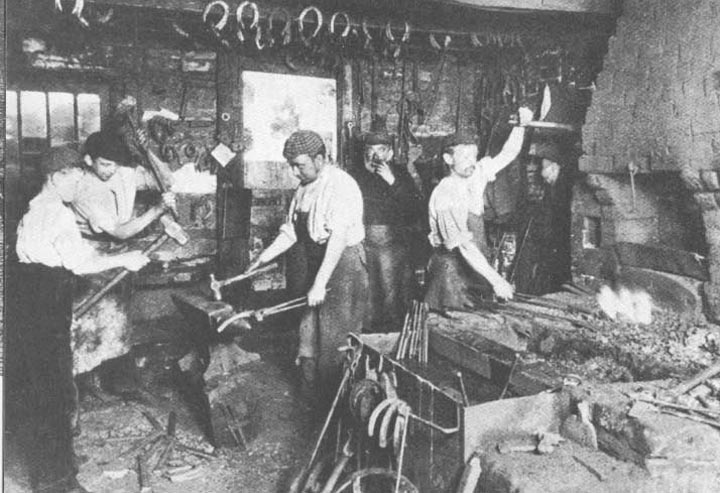
Like his father before him, John became a blacksmith.
By his twenties, he had completed the years of apprenticeship required to become a journeyman blacksmith, a highly skilled tradesman employed for wages rather than operating his own forge.
Unlike the traditional village blacksmith who spent his days shoeing horses or repairing farm tools, John’s career was almost certainly centered in heavy industry.
As I learned more about the coalfields surrounding Old Monkland, it became increasingly clear that his forge was part of the machinery that powered Scotland’s industrial success.
Marriage and Family
On 24 February 1854, John married Janet Gray in Shettleston.
Together they made their home in Old Monkland and raised a family that included:
- Janet Robertson
- John Robertson
- James Robertson
- Alexander Robertson
- Agnes Robertson
Sadly, tragedy struck in 1862 when Janet died, leaving John a widower at only thirty-five years of age. Despite living another forty years, I have found no evidence that he ever remarried.
Life in the Collieries
The census records gradually begin painting a vivid picture of John’s working life.
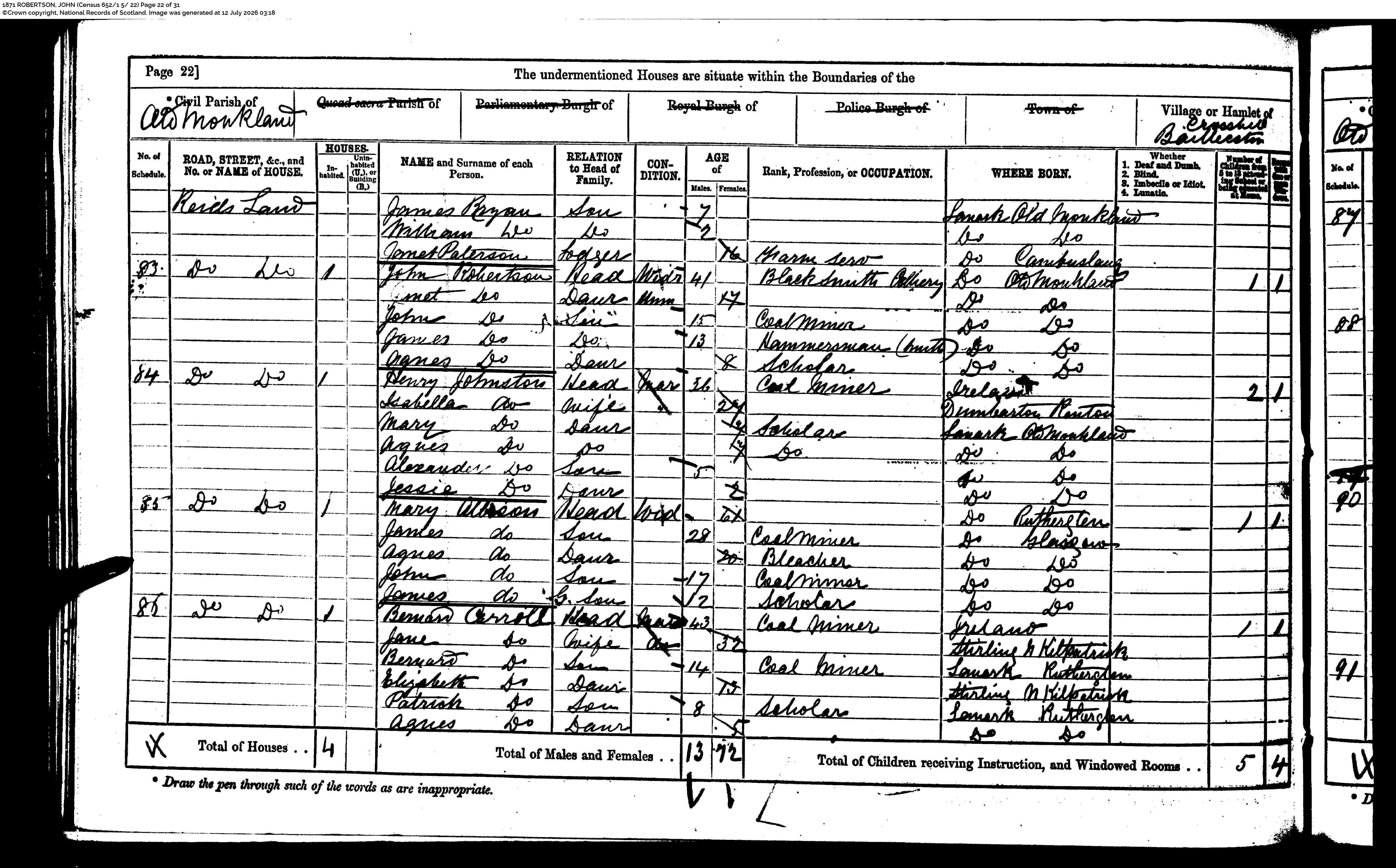
1871 Census
The family was living at Reids Land in the Crosshill district of Old Monkland, surrounded by some of Scotland’s busiest coal and ironstone mines.
One detail immediately caught my attention.
John’s thirteen-year-old son James was already employed as a Hammerman, likely assisting experienced blacksmiths by striking heated iron with heavy sledges while learning the trade.
The industrial workforce had already become a family occupation.
1881 Census
Ten years later, another fascinating detail appears.
John was still working as a blacksmith, while James had become a Colliery Engine Keeper.
This was no ordinary laborer’s position.
Engine keepers maintained the massive steam engines that powered winding gear, pumps, and haulage systems throughout the mines. These engines were the beating heart of every colliery.
It is easy to imagine father and son working in the same industrial complex.
John repaired the machinery.
James kept it running.
1891 Census
By 1891, the family was living at Braehead No. 5 Pit, part of the extensive Bredisholm and Faskine Colliery network.
Historical maps reveal engine houses, mineral railways, pithead buildings, rows of workers’ cottages, and an enormous network of mining operations stretching across the landscape.
This discovery transformed my understanding of John’s life.
Rather than simply repairing horseshoes, he was almost certainly forging and repairing the equipment that kept an entire colliery functioning.
His work likely included:
- Pit cages
- Haulage chains
- Winding-engine components
- Pumping machinery
- Mine wagons
- Rails and switches
- Picks and mining tools
- Iron fittings used throughout the mine
When machinery failed, production stopped.
A skilled blacksmith like John kept the mines moving.
A Trade Passed from Father to Son
James Robertson’s occupations tell a story all their own.
Across successive census records, he appears as:
- Hammerman (1871)
- Colliery Engine Keeper (1881)
- Blacksmith (1901)
This progression reflects the close relationship between the engineering trades of Lanarkshire’s coalfields.
While no document describes their daily lives, it is difficult not to imagine James learning beside his father, holding glowing iron with long tongs while John judged the metal’s temperature by its color and guided each swing of the hammer.
These are the moments that genealogy cannot prove, yet history allows us to reasonably imagine.
John’s Final Years
After nearly forty years as a widower, John spent his later years surrounded by family.
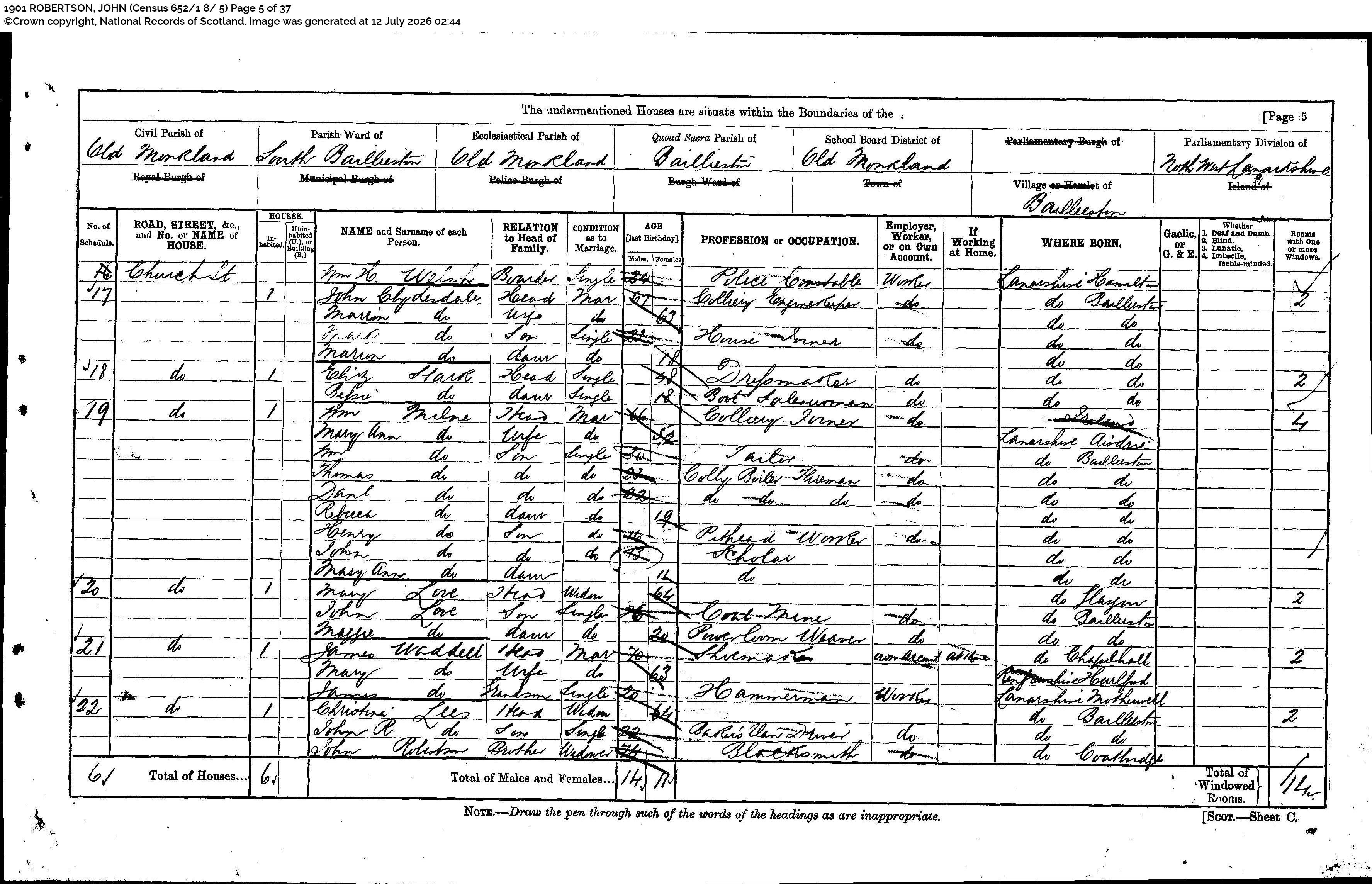
The 1901 Census records him living with his widowed sister, Christina (Robertson) Lees, a relationship later confirmed in John’s own will.
His occupation was still listed simply as: Blacksmith Whether he was still working or whether the census merely recorded the trade that had defined his life is impossible to know.
His will, written in May 1902, places him at Eastmuir, Shettleston, before he later moved to the home of his son James in Cathcart, where he spent his final months.
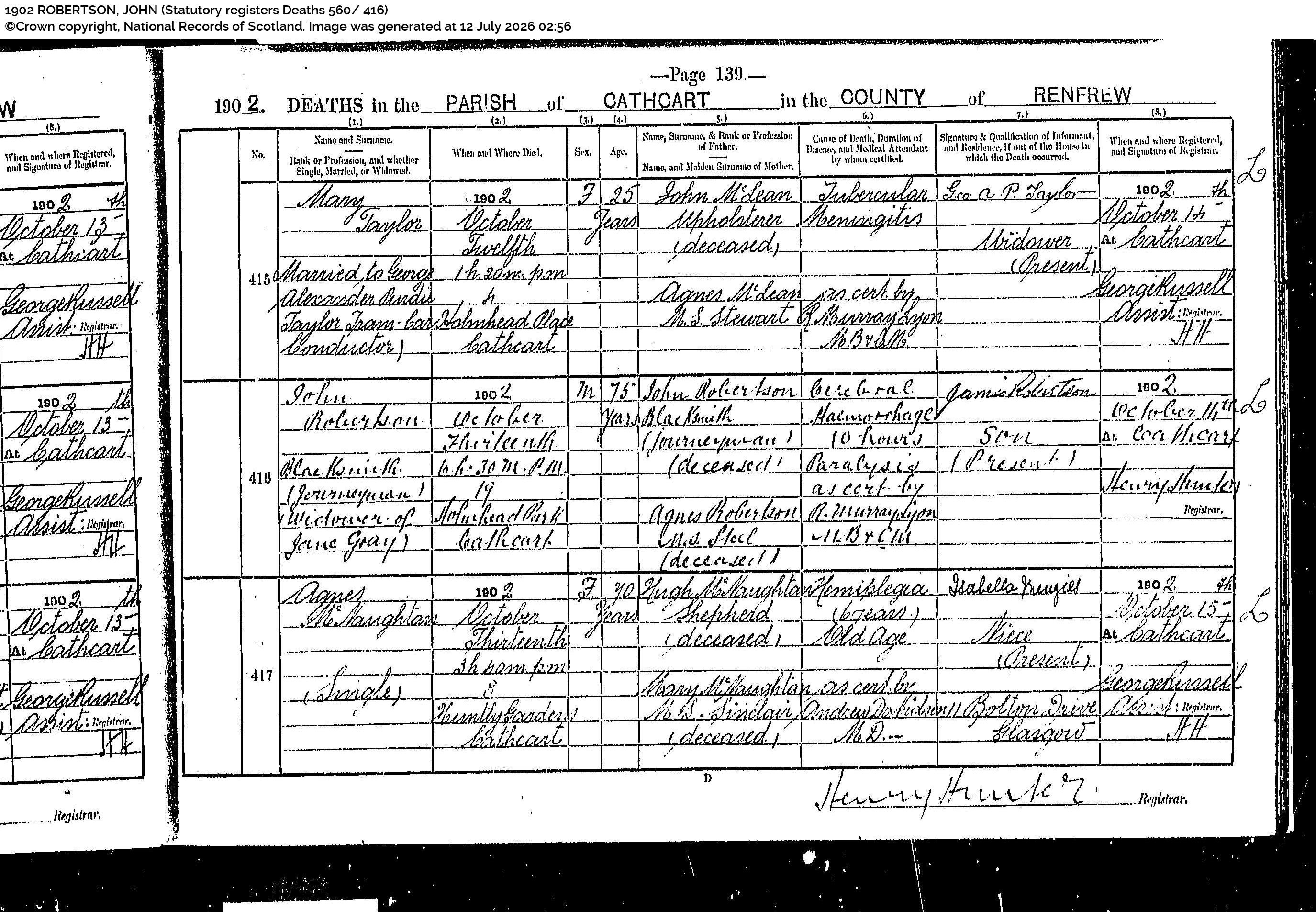
John Robertson died there on 13 October 1902. He was laid to rest in Sandymount Cemetery.
Remembering John Robertson
History often celebrates mine owners, industrialists, and inventors.
Far less often do we hear about the craftsmen whose skill made their success possible.
John Robertson was one of those men.
For perhaps half a century he stood beside a blazing forge in the collieries of Old Monkland, shaping iron that kept engines turning, cages lifting, rails moving, and miners working.
The ringing of his hammer would have echoed across the coalfields every working day. Although that sound faded more than a century ago, the records he left behind allow us to hear it once again.
That, to me, is one of the greatest rewards of genealogy. It allows us not only to discover who our ancestors were, but to appreciate the lives they lived and the legacy they quietly left behind.
Sources
This reconstruction of John Robertson’s life is based upon original Scottish records and contemporary historical research, including:
- Old Monkland Parish baptism registers
- Scottish census returns (1871, 1881, 1891, and 1901)
- Marriage records of his children
- Death registration (1902)
- Will and Testament, Paisley Sheriff Court (1902)
- Sandymount Cemetery burial records
- Historical maps and records of the Braehead, Bredisholm, and Faskine Collieries
- Valuation Rolls
- Local industrial histories of Old Monkland and the Lanarkshire coalfields
Some aspects of John’s employment, including the specific colliery company for which he worked, remain informed by the available evidence rather than explicitly documented. Where conclusions are drawn, they are based on the consistent pattern of census occupations, family records, residences, and the industrial history of Old Monkland. As with all genealogical research, future discoveries may refine or expand this story.


